
A flashcard stores information on a set of cards, with the information being typically portrayed as words and numbers. The purpose of flashcards is to enable individuals to store verbal and visual information, often as a learning drill by way of spaced repetition. The Leitner system is a popular method of studying with flashcards using spaced repetition.
When you learn flashcards of new words each day for a number of days, this information is stored in your short-term memory. Flashcards also exercise the mental process of active recall. This is an efficient learning principle where an individual’s memory is stimulated during the learning process. Unlike a passive review (e.g. reading a book), active recall is designed to consolidate long-lasting memory of information. Transferring information from short-term to long-term memory is essential in studying for an examination.
Flashcards are one of the best tools for memorizing information. This is partly because of their versatility. They can help teach multiplication skills, learn a foreign language, recall facts, historical dates, in fact anything that can be learned in an intuitive way.
To provide an insight into the quality of software available, we have compiled a list of 16 useful GUI flashcard applications. Hopefully there will be something of interest for anyone who wants to memorize information. Here’s our verdict on each of the open source applications. Only free and open source software is eligible for inclusion here.
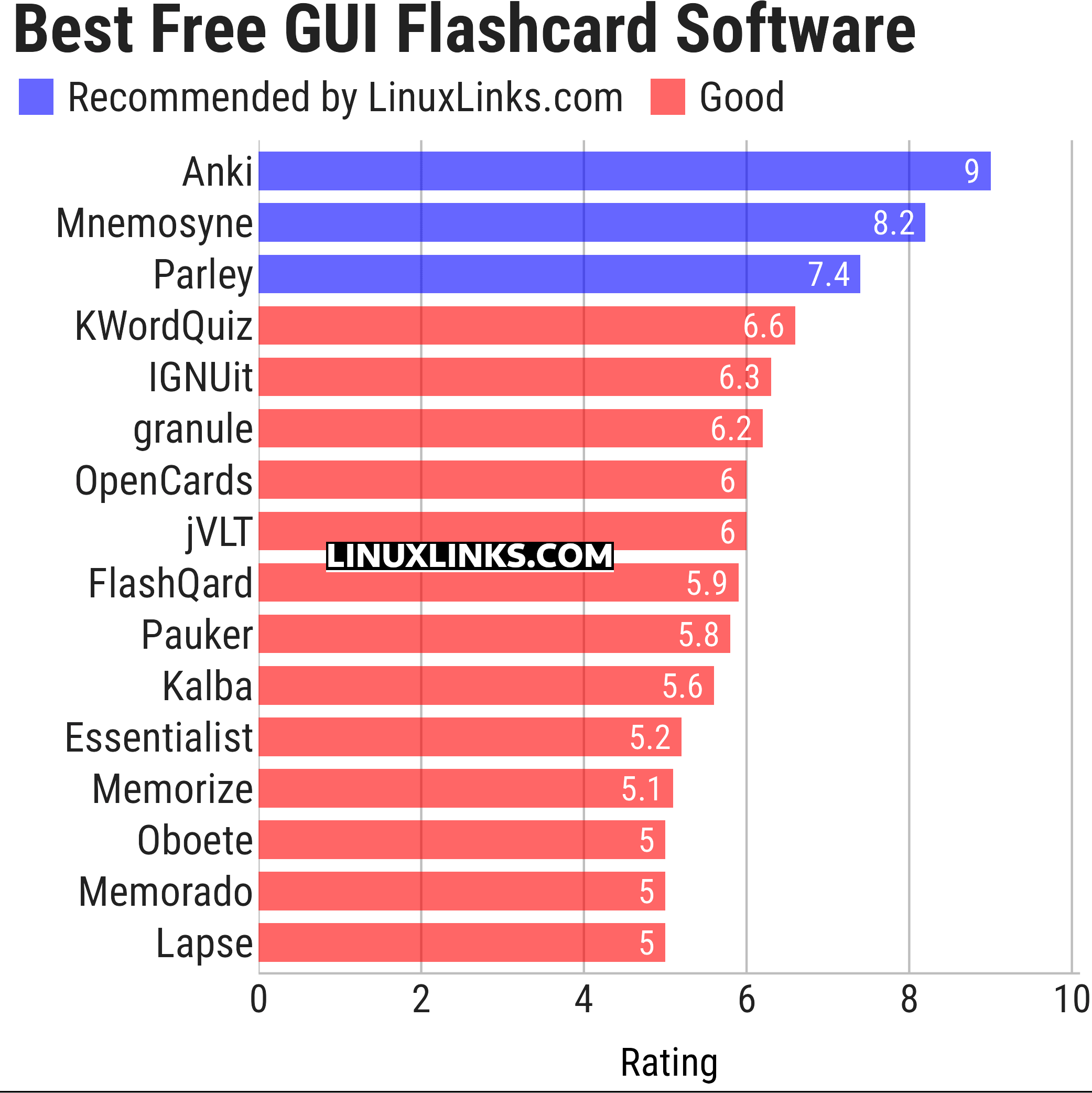
Let’s explore the 16 flashcard applications at hand. For each title we have compiled its own portal page, providing a screenshot of the software in action, a full description with an in-depth analysis of its features, together with links to relevant resources.
| GUI Flashcard Software | |
|---|---|
| Anki | Extensible flashcard learning program |
| Mnemosyne | Spaced repetition flashcard program |
| Parley | Vocabulary trainer for KDE |
| KWordQuiz | Flashcard learning program for KDE |
| IGNUit | Memorization aid based on the Leitner flashcard system |
| granule | Short-term and long-term memory training capabilities with scheduling |
| OpenCards | Award-winning flashcard learning software |
| jVLT | Vocabulary learning tool |
| FlashQard | Improve your learning process using the Leitner System |
| Pauker | Generic card based learning program |
| Kalba | Language learning tool based on the idea of sentence mining. |
| Essentialist | Simple, private, and cross-platform flashcard app |
| Memorize | Store flashcard sets |
| Oboete | Simple flashcards application for the COSMIC desktop |
| Memorado | Learn using spaced repetition |
| Lapse | Flashcard application built with Flutter |
Looking for terminal-based flashcard tools. They are covered in a separate roundup.
This article has been updated to reflect the changes outlined in our recent announcement.
 Explore our comprehensive directory of recommended free and open source software. Our carefully curated collection spans every major software category. Explore our comprehensive directory of recommended free and open source software. Our carefully curated collection spans every major software category.This directory is part of our ongoing series of informative articles for Linux enthusiasts. It features hundreds of detailed reviews, along with open source alternatives to proprietary solutions from major corporations such as Google, Microsoft, Apple, Adobe, IBM, Cisco, Oracle, and Autodesk. You’ll also find interesting projects to try, hardware coverage, free programming books and tutorials, and much more. Know a useful open source Linux program that we haven’t covered yet? Let us know by completing this form. |
Please read our Comment Policy before commenting.
Thanks for this
Linux is a bit lightweight in this area.