
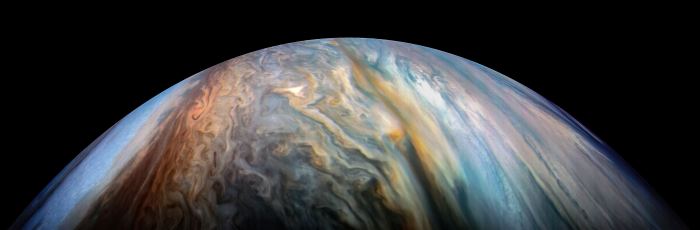
Astronomy is a branch of science that deals with the study of celestial objects (including stars, planets, moons, comets, asteroids, meteor showers, nebulae, star clusters, galaxies) and other phenomena such as gamma ray bursts and supernovae.
Astronomy is particularly well suited to the layperson. It is a wonderful hobby which has almost no age limits, it is open to individuals of all financial means, and there is always the potential for an amateur to discover something that has eluded professional astronomers, or to help monitor stars and track asteroids. Professional astronomers are in a very fortunate profession. They have the opportunity to continue their love of astronomy, travel the world, make significant discoveries, and get paid at the same time.
Professional astronomers spend far more of their time analyzing data and writing articles than actually observing celestial objects. Amateur astronomers are also keen to analyze the data they have collated. Software that can process and analyze images is therefore essential to astronomers. Fortunately, high performance scientific software has always been a strong area for Linux.
Flexible Image Transport System (FITS) is a digital file format used to store, transmit, and manipulate scientific and other images. FITS is the most commonly used digital file format in astronomy.
We give our highest recommendation to Astropy, CARTA and AstroImageJ. But there are lots of other great tools. Only free and open source software is eligible for inclusion here.
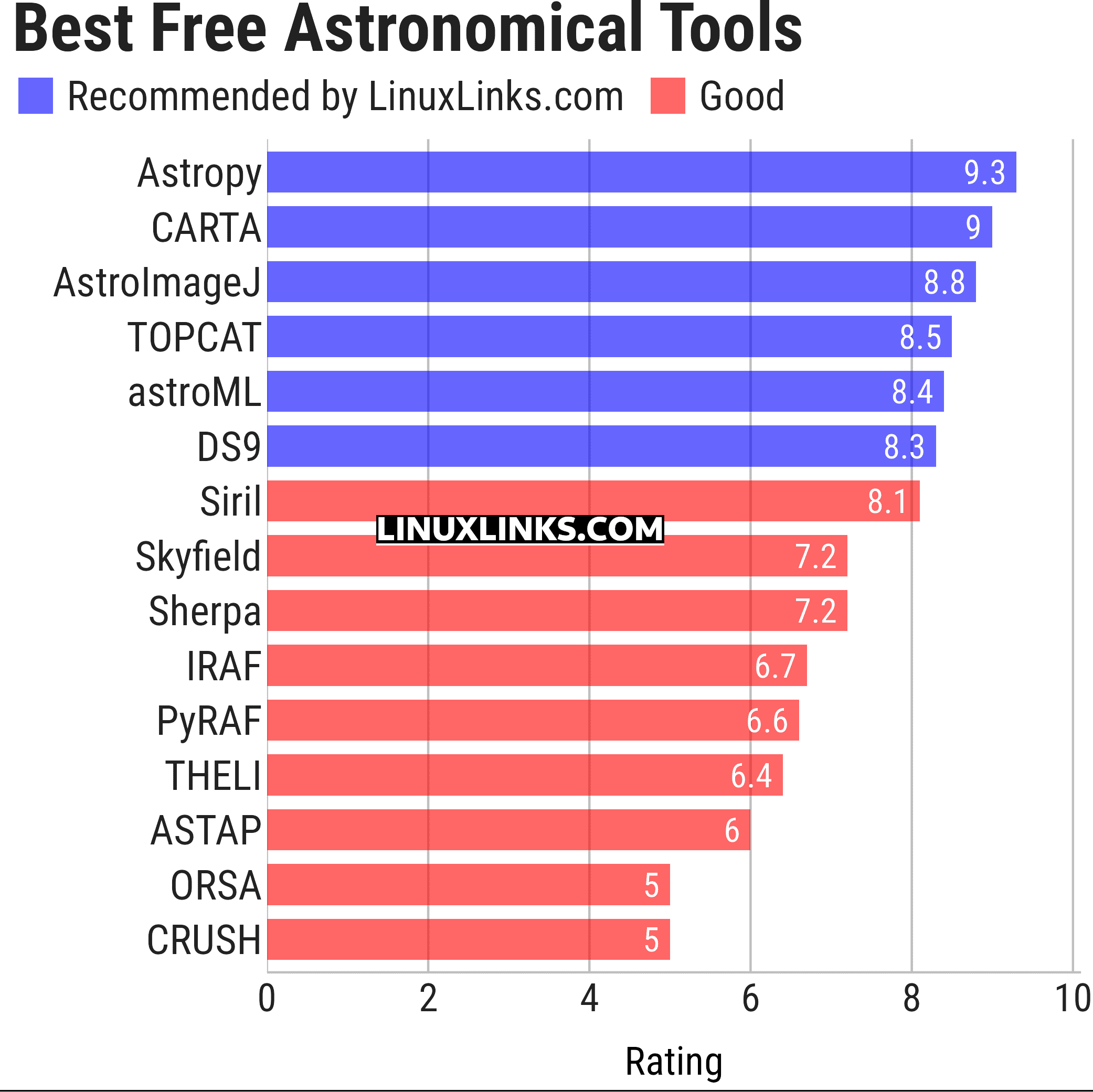
Click the links in the table below to learn more about each tool.
| Astronomical Data Analysis Tools | |
|---|---|
| Astropy | Collection of Python software packages for astronomy |
| CARTA | Cube Analysis and Rendering Tool for Astronomy |
| AstroImageJ | Powerful tool for astronomical image analysis and precise photometry |
| TOPCAT | Tool for OPerations on Catalogues And Tables |
| astroML | Python module for machine learning and data mining |
| DS9 | Astronomical imaging and data visualization application |
| Siril | Astronomical image (pre-)processing software |
| Skyfield | Pure-Python astronomy package |
| Sherpa | Modeling and fitting application for Python |
| IRAF | Image Reduction and Analysis Facility |
| PyRAF | Python-based IRAF command language |
| THELI | Tool for the automated reduction of astronomical images |
| SunPy | Python ecosystem for accessing and analysing solar physics data |
| Gammapy | Python package for analysing gamma-ray astronomical observations |
| jdaviz | Interactive visualisation and analysis suite for astronomical data |
| Gnuastro | Processes and analyses astronomical datasets |
| ASTAP | Astrometric STAcking Program |
| FIPS | OpenGL FITS image viewer for astronomical data |
| ORSA | Framework for celestial mechanics investigations |
| CRUSH | Data reduction and imaging for select astronomical cameras |
This article has been updated to reflect the changes outlined in our recent announcement.
 Explore our carefully curated directory of recommended free and open source software, covering every major software category. Explore our carefully curated directory of recommended free and open source software, covering every major software category.The directory forms part of our extensive collection of articles for Linux enthusiasts. It includes hundreds of detailed reviews, together with free and open source alternatives to proprietary software from companies such as Google, Microsoft, Apple, Adobe, IBM, Cisco, Oracle, and Autodesk. LinuxLinks also covers interesting projects worth exploring, Linux-compatible hardware, free programming books and tutorials, and much more. Know a useful free and open source Linux application that we haven’t covered? Tell us about it using our submission form. |
Please read our Comment Policy before commenting.