

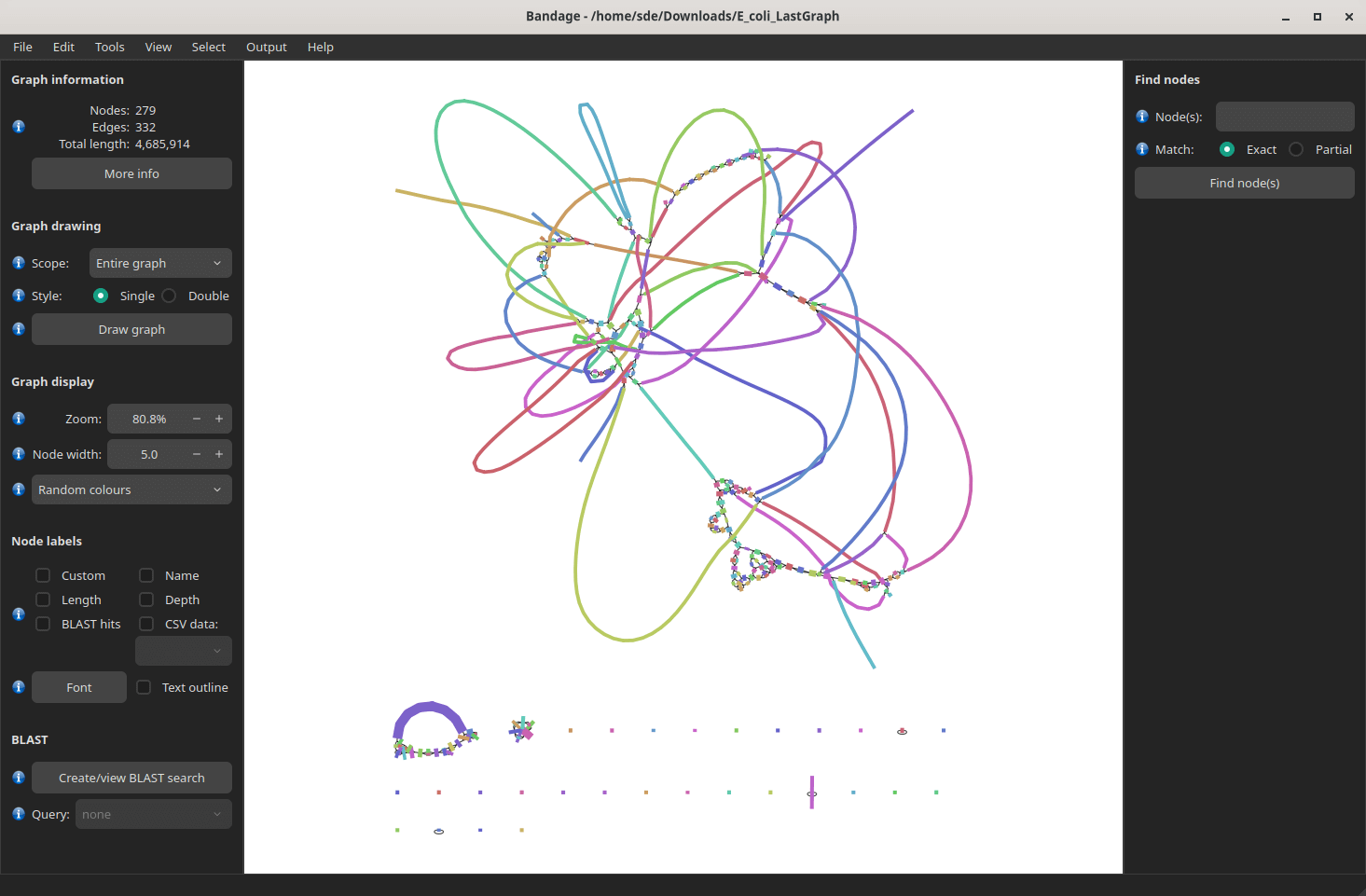
Bandage is a program for visualising de novo assembly graphs.
By displaying connections which are not present in the contigs file, Bandage opens up new possibilities for analysing de novo assemblies.
This is free and open source software.
Key Features
- Load multiple assembly graph formats: LastGraph (Velvet), FASTG (SPAdes), Trinity.fasta, ASQG and GFA.
- Position nodes automatically with an efficient graph layout algorithm.
- Zoom, pan and rotate the view using either mouse or keyboard controls.
- Reposition and reshape nodes by clicking and dragging with the mouse.
- Configure graph scope: view the entire assembly graph or only a region of interest.
- Copy node sequences to the clipboard or save them to file.
- Colour nodes using built-in colour schemes or user-defined colours.
- Label nodes using node number, length, coverage or user-defined labels.
- Find nodes quickly in a large graph using node numbers.
- Specify the thickness of nodes and allow thickness to reflect the node’s read depth.
- Define the relationship between the length of a node and the length of its sequence.
- Draw graph in single node style: each node and its reverse complements appear as a single object.
- Draw graph in double node style: nodes and their reverse complements appear as separate objects with arrow heads to indicate direction.
- Highlight and label specific sequences with integrated BLAST search.
- Automatically identify nodes contiguous with a node of interest.
- Call Bandage from the command line to specify settings, load graphs or generate images.
- Cross-platform support – runs under Linux, macOS, and Windows.
Website: rrwick.github.io/Bandage
Support: GitHub Code Repository
Developer: Ryan Wick
License: GNU General Public License v3.0
Bandage is written in C++. Learn C++ with our recommended free books and free tutorials.
Related Software
| Bioinformatics Tools | |
|---|---|
| Bioconductor | Analysis and comprehension of high-throughput genomic data |
| Biopython | Tools for biological computation written in Python |
| UGENE | Set of integrated bioinformatics software |
| BioPerl | Perl tools for computational molecular biology |
| GROMACS | Versatile package to perform molecular dynamics |
| IGV | High-performance visualization genome browser tool |
| GATK | Genomic analysis toolkit focused on variant discovery |
| BioJava | Provides Java tools for processing biological data |
| InterMine | Integrate biological data sources |
| bedtools | Powerful toolset for genome arithmetic |
| EMBOSS | The European Molecular Biology Open Software Suite |
| BLAST | Algorithm for comparing primary biological sequence information |
| Galaxy | Web-based platform for data-intensive computational research |
| minimap2 | Versatile sequence alignment program |
| Scanpy | Scalable analysis of single-cell gene expression data |
| Jalview | Multiple sequence alignment editing, visualisation and analysis |
| SeqKit | Fast toolkit for manipulating FASTA and FASTQ sequence files |
| samtools | Manipulate next-generation sequencing data |
| MultiQC | Aggregates results from multiple bioinformatics analyses |
| BCFtools | Variant calling and manipulating files in the Variant Call Format |
| Foldseek | Fast searching and comparison of large protein structure datasets |
| FastQC | Quality control tool for high throughput sequence data |
| SPAdes | Versatile toolkit for assembling and analysing sequencing data |
| GenomeTools | Collection of bioinformatics tools |
| AliView | Alignment viewer and editor |
| mothur | Analyze microbial communities |
| Bandage | Visualising de novo assembly graphs |
| cramino | BAM/CRAM quality evaluation |
| abPOA | Adaptive banded Partial Order Alignment |
Read our verdict in the software roundup.
 Explore our comprehensive directory of recommended free and open source software. Our carefully curated collection spans every major software category. Explore our comprehensive directory of recommended free and open source software. Our carefully curated collection spans every major software category.This directory is part of our ongoing series of informative articles for Linux enthusiasts. It features hundreds of detailed reviews, along with open source alternatives to proprietary solutions from major corporations such as Google, Microsoft, Apple, Adobe, IBM, Cisco, Oracle, and Autodesk. You’ll also find interesting projects to try, hardware coverage, free programming books and tutorials, and much more. Discovered a useful open source Linux program that we haven’t covered yet? Let us know by completing this form. |
Please read our Comment Policy before commenting.