

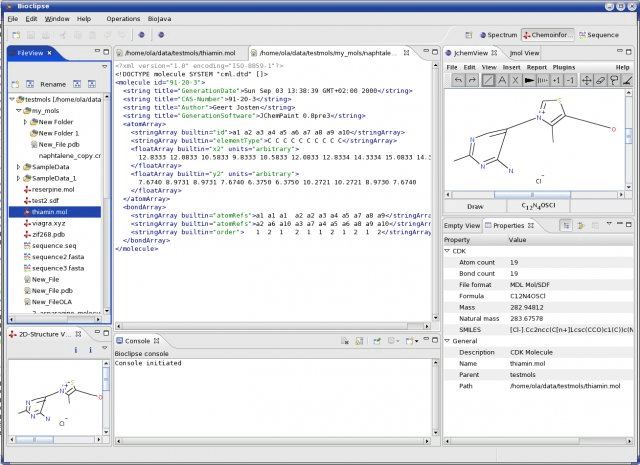
The Bioclipse project is a Java-based, open source, visual platform for chemo- and bioinformatics based on the Eclipse Rich Client Platform (RCP).
Bioclipse uses a plugin architecture that inherits a state-of-the-art plugin architecture, functionality, and visual interfaces from Eclipse, such as help system, software updates, preferences, cross-platform deployment, and more.
Bioclipse provides functionality for chemo- and bioinformatics, and extension points that easily can be extended by other, possibly proprietary, plugins to provide additional functionality.
Key Features
- Bioinformatics:
- Manage and analyse biological sequences (DNA, RNA, and protein).
- Relies on BioJava to provide core bioinformatics functionality and a graphical editor for sequence alignments.
- Clients for web services.
- Plugin architecture based on Eclipse.
- Cheminformatics in Bioclipse is mainly based on the Chemistry Development Kit (CDK), and contains a framework for managing and analyzing chemical compounds. It supports:
- Process large collections of molecules in tables.
- Calculation of various types of property.
- Editing in 2D.
- Pharmacology and drug discovery.
- Advanced tools for interacting with semantic web resources.
- Facilitates working with decision support systems.
- Rich client and takes full advantage of networked resources, such as databases and interoperable Web services, XMPP services.
- Site-of-metabolism prediction.
- Semantic web functionality.
- Browsing of large compound collections.
- Editing of chemical structures.
- Scripting language (Bioclipse Scripting Language, or BSL) which can be used to automate tasks or create reusable snippets that can be shared with others.
- Platform independent.
Website: sourceforge.net/projects/bioclipse
Support: Blog
Developer: The Bioclipse Project
License: Eclipse Public License
Bioclipse is written in Java. Learn Java with our recommended free books and free tutorials.
Related Software
| Bioinformatics Tools | |
|---|---|
| Bioconductor | Analysis and comprehension of high-throughput genomic data |
| Biopython | Tools for biological computation written in Python |
| UGENE | Set of integrated bioinformatics software |
| BioPerl | Perl tools for computational molecular biology |
| GROMACS | Versatile package to perform molecular dynamics |
| IGV | High-performance visualization genome browser tool |
| GATK | Genomic analysis toolkit focused on variant discovery |
| BioJava | Provides Java tools for processing biological data |
| InterMine | Integrate biological data sources |
| bedtools | Powerful toolset for genome arithmetic |
| EMBOSS | The European Molecular Biology Open Software Suite |
| BLAST | Algorithm for comparing primary biological sequence information |
| Galaxy | Web-based platform for data-intensive computational research |
| minimap2 | Versatile sequence alignment program |
| Scanpy | Scalable analysis of single-cell gene expression data |
| Jalview | Multiple sequence alignment editing, visualisation and analysis |
| SeqKit | Fast toolkit for manipulating FASTA and FASTQ sequence files |
| samtools | Manipulate next-generation sequencing data |
| MultiQC | Aggregates results from multiple bioinformatics analyses |
| BCFtools | Variant calling and manipulating files in the Variant Call Format |
| Foldseek | Fast searching and comparison of large protein structure datasets |
| FastQC | Quality control tool for high throughput sequence data |
| SPAdes | Versatile toolkit for assembling and analysing sequencing data |
| GenomeTools | Collection of bioinformatics tools |
| AliView | Alignment viewer and editor |
| mothur | Analyze microbial communities |
| Bandage | Visualising de novo assembly graphs |
| cramino | BAM/CRAM quality evaluation |
| abPOA | Adaptive banded Partial Order Alignment |
Read our verdict in the software roundup.
 Explore our comprehensive directory of recommended free and open source software. Our carefully curated collection spans every major software category. Explore our comprehensive directory of recommended free and open source software. Our carefully curated collection spans every major software category.This directory is part of our ongoing series of informative articles for Linux enthusiasts. It features hundreds of detailed reviews, along with open source alternatives to proprietary solutions from major corporations such as Google, Microsoft, Apple, Adobe, IBM, Cisco, Oracle, and Autodesk. You’ll also find interesting projects to try, hardware coverage, free programming books and tutorials, and much more. Discovered a useful open source Linux program that we haven’t covered yet? Let us know by completing this form. |
Please read our Comment Policy before commenting.