
Let’s clear up one potential source of confusion at the outset. What’s the difference between Machine Learning and Deep Learning? The two terms mean different things.
In essence, Machine Learning is the practice of using algorithms to parse data, learn insights from that data, and then make a determination or prediction. The machine is ‘trained’ using huge amounts of data.
Deep Learning is a subset of Machine Learning that uses multi-layers artificial neural networks to deliver state-of-the-art accuracy in tasks such as object detection, speech recognition, language translation and others. Think of Machine Learning as cutting-edge, and Deep Learning as the cutting-edge of the cutting-edge.
Both Machine Learning and Deep Learning are changing the world. Deep Learning is trending.
Why is Deep Learning gaining so much momentum? It’s mainly due to its many successes in the field of computer vision, automatic speech recognition and natural language processing. With the availability of huge amounts of data for research and powerful machines to run your code on with distributed cloud computing and parallelism across GPU cores, Deep Learning has helped to create self-driving cars, intelligent voice assistants, pioneer medical advancements, machine translation, and much more. Deep Learning has become an indispensable tool for countless industries.
To provide an insight into the best software that is available, we have compiled a list of 17 incredibly useful free Python software for Deep Learning. Our recommendations are captured in this ratings chart. They are all free and open source software.
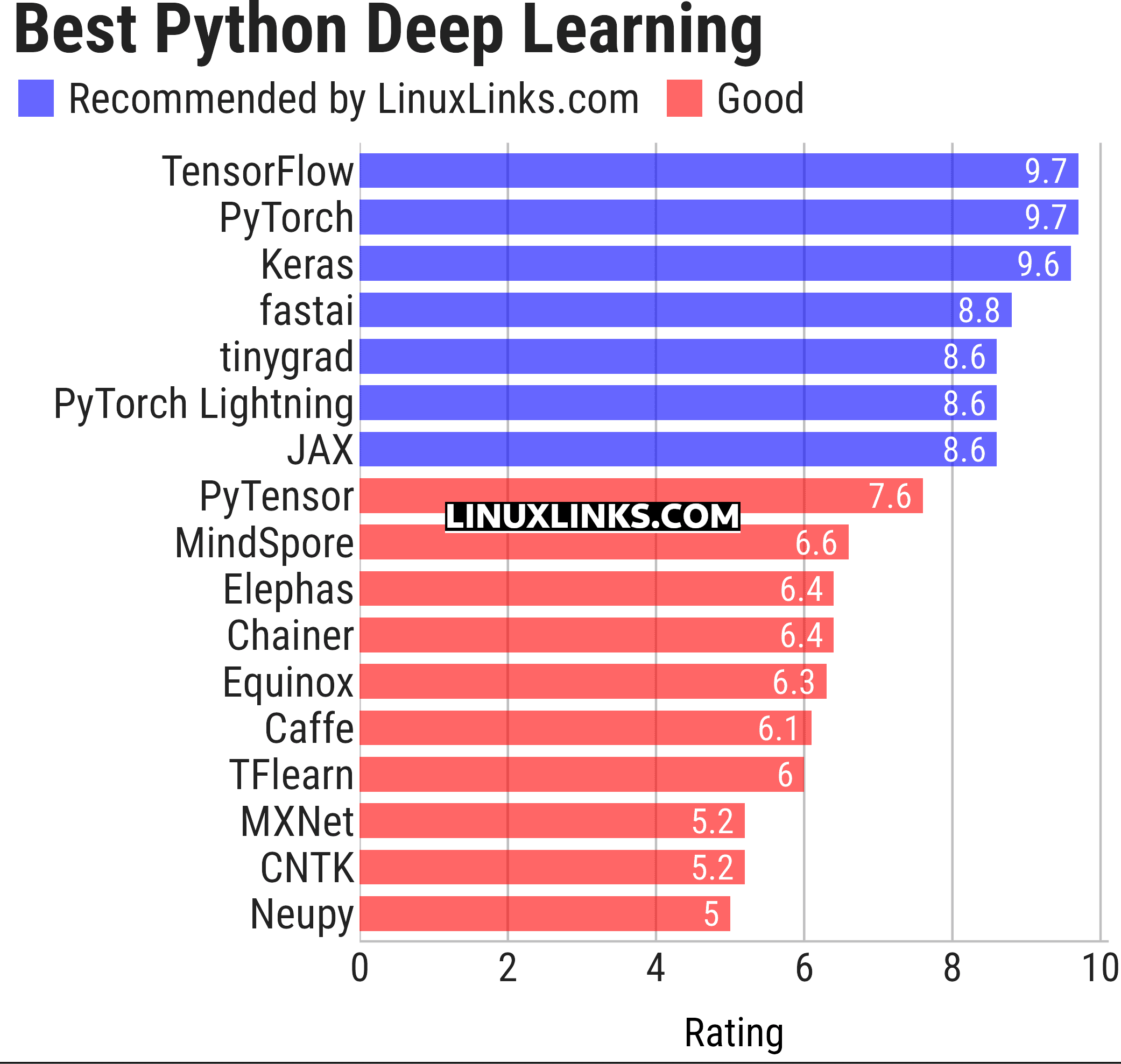
Click the links in the table below to learn more about each program.
| Deep Learning with Python | |
|---|---|
| TensorFlow | A very popular Deep Learning framework |
| PyTorch | Tensors and Dynamic neural networks in Python |
| Keras | High-level neural networks API |
| fastai | Simplifies training fast and accurate neural networks |
| tinygrad | Compact, lightweight deep learning framework |
| PyTorch Lightning | Framework for scaling PyTorch training workflows |
| JAX | High-performance numerical computing and ML library |
| PyTensor | Library for fast numerical computation |
| MindSpore | Framework for training and deploying neural networks |
| Elephas | Distributed deep learning with Keras and Spark |
| Chainer | Powerful, flexible, and intuitive framework for neural networks |
| Equinox | Neural network library for building flexible models with JAX |
| Caffe | Convolutional Architecture for Fast Feature Embedding |
| TFlearn | Deep learning library featuring a higher-level API for TensorFlow |
| MXNet | Flexible and efficient library |
| CNTK | Distributed deep learning |
| Neupy | Python library for neural networks and deep learning |
We have written reviews for many self-hosted machine learning applications, many of which rely on the software featured here.
The eagle-eyed among you will recognize some of the software is not predominately written in Python. But all of the software provides, at the very least, a Python interface.
This article has been updated to reflect the changes outlined in our recent announcement.
 Explore our comprehensive directory of recommended free and open source software. Our carefully curated collection spans every major software category. Explore our comprehensive directory of recommended free and open source software. Our carefully curated collection spans every major software category.This directory is part of our ongoing series of informative articles for Linux enthusiasts. It features hundreds of detailed reviews, along with open source alternatives to proprietary solutions from major corporations such as Google, Microsoft, Apple, Adobe, IBM, Cisco, Oracle, and Autodesk. You’ll also find interesting projects to try, hardware coverage, free programming books and tutorials, and much more. Know a useful open source Linux program that we haven’t covered yet? Let us know by completing this form. |
Please read our Comment Policy before commenting.