
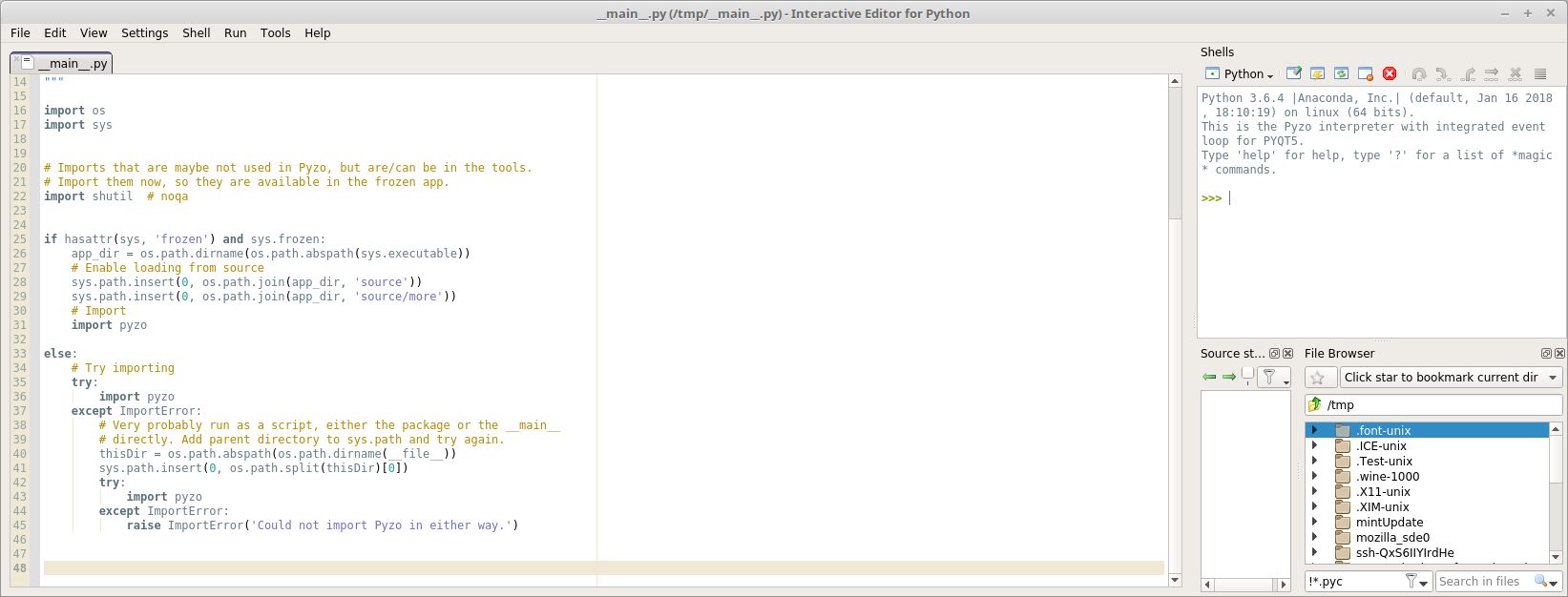
Pyzo is a small, open source, cross-platform, Python IDE focused on interactivity and introspection. It’s a good environment for developers focused on scientific computing. Its practical design is aimed at simplicity and efficiency.
Pyzo consists of two main components, the editor and the shell, and uses a set of pluggable tools to help the programmer in various ways. Some example tools are source structure, project manager, interactive help, and a workspace.
The software is written in (pure) Python 3 and uses the Qt GUI toolkit. Binaries are provided for all major operating system which makes it quick to get started.
Pyzo uses code and concepts that are inspired by IPython, Pype, and Spyder.
Key Features
- Introspection information is queried from the active shell, and from the source code (by continuously parsing the file in a separate thread).
- Auto completion for any object in the active Python session and all __builtins__.
- Optional auto completion for Python keywords.
- Auto completion for functions, classes, and class attributes defined in the current file in the editor (taking inheritance into account, even if a super class is defined in the shell).
- Shows signature of functions (from the shell or from the source) using a call-tip.
- Interactive help for all objects in the active Python session by moving up/down the auto completion list, by double-clicking on a name, or by filling in the name directly.
- Interactive help show the docstrings of properties (rather than of the returned object).
- Allows various ways to interactively run code.
- Using an intuitive shortcut editor, a shortcut can be created for any item in the menu.
- Choose between different Qt themes.
- Full Unicode support in both editor and shell.
- Editor:
- Supports auto indentation.
- Automatically determines the indentation width when loading a file.
- Matlab-style cell system to mark code sections (by starting a line with ‘##’).
- Syntax highlighting for Python, Cython, C, and more to come.
- Supports commenting and uncommenting selected lines.
- Drag-‘n-drop files or directories to open them.
- Find/Replace (also supports regular expressions).
- The line ending style can be changed.
- Optionally use tabs, or insert tabs as spaces.
- Indentation guides.
- View whitespace / line endings.
- Zooming.
- Undo / redo.
- Highlighting of current line.
- Long line indicator.
- Choice of multiple fonts, Pyzo comes with two attractive fonts.
- Breakpoints for debugging.
- Various handy tools included, plus the ability to make your own.
- File browser – list all files in your projects by bookmarking the directories of your projects. Easy switching between projects.
- History viewer.
- Interactive help – displays help information interactively (on selection and scrolling through an autocompletion list).
- Logger – a logger shell that displays Pyzo’s log messages and can be used for development or for changing advanced settings.
- Source structure – lists the structure of the source in a tree widget. It can list classes, functions (and methods), import statements, cells, and todo items.
- Web browser.
- Workspace – lists all variables (also in debug mode).
- Export to PDF.
- Syntax parsing: Python, Python 2, Python 3, Plain, C, sexpr, cpython, and wat.
Website: www.pyzo.org
Support: Guide, GitHub Code Repository, Mailing List
Developer: Almar Klein and many contributors
License: BSD License
Learn Python with our recommended free books and free tutorials.
Related Software
| Python Integrated Development Environments | |
|---|---|
| PyCharm | Full-featured IDE. Two editions are available, one is open source software |
| Spyder | Python development environment providing MATLAB-like features |
| eric | Full featured Python editor and IDE, written in Python |
| Thonny | Tk-based IDE designed for novice programmers |
| PyDev | Python plugin for Eclipse |
| Leo | PIM, IDE and outliner |
| Pyzo | Interactive editor for scientific Python |
| PTK | Interactive environment for Python |
| IDLE | Python’s Integrated Development and Learning Environment |
Read our verdict in the software roundup.
| Integrated Development Environments | |
|---|---|
| RStudio | Enterprise-ready professional software for R |
| PyCharm | Integrated Development Environment for Python |
| Neovim | Continuation and extension of Vim |
| Lapce | Fast and powerful code editor written in Rust |
| NetBeans IDE | Java based IDE from Apache |
| VSCodium | Binary distribution of VS Code |
| Eclipse | Java based environment combining a number of different Eclipse projects |
| Qt Creator | Cross-platform, complete Integrated Development Environment |
| Spyder | The Scientific Python Development Environment |
| KDevelop | An easy to use IDE for KDE |
| Helix | Post-modern modal text editor |
| Theia | Cloud & desktop IDE framework |
| eric | Full featured Python editor and IDE |
| Thonny | Python Integrated Development Environment for Beginners |
| Lazarus | Delphi compatible cross-platform IDE |
| PyDev | Python Integrated Development Environment for Eclipse |
| Gambas | Development environment and a full powerful development platform |
| Che | Kubernetes based Cloud Development Environments for Enterprise Teams |
| Leo | Python based IDE, Outliner and PIM |
| IntelliJ IDEA | IDE for Java, Groovy, and other languages |
| LiteIDE | Edit and build Go projects |
| Arduino IDE | Electronics prototyping platform |
| ZeroBrane Studio | Lightweight Lua-based IDE for Lua |
| CodeLite | Powerful and lightweight C/C++ IDE |
| Pyzo | Cross-Platform Python IDE focused on interactivity and introspection |
| DrRacket | IDE for the Racket programming languages |
| Builder | IDE for GNOME |
| Geany | Small and lightweight IDE based on Scintilla |
| Code::Blocks | Very extensible and fully configurable |
| Ecere SDK | Software development kit |
| Zasper | IDE for Data Science |
| U++ | Rapid application development framework |
| roobuilder | Vala and JavaScript IDE |
Read our verdict in the software roundup.
 Explore our comprehensive directory of recommended free and open source software. Our carefully curated collection spans every major software category. Explore our comprehensive directory of recommended free and open source software. Our carefully curated collection spans every major software category.This directory is part of our ongoing series of informative articles for Linux enthusiasts. It features hundreds of detailed reviews, along with open source alternatives to proprietary solutions from major corporations such as Google, Microsoft, Apple, Adobe, IBM, Cisco, Oracle, and Autodesk. You’ll also find interesting projects to try, hardware coverage, free programming books and tutorials, and much more. Discovered a useful open source Linux program that we haven’t covered yet? Let us know by completing this form. |
Please read our Comment Policy before commenting.