

Security is paramount. Security involves defence in depth. Approaching security one step at a time, with consistency and rigour, you can mitigate threats, and keep intruders at bay.
Intruders use a variety of different techniques in an attempt to compromise a system. For example, systems can be attacked by denial of service, cracking, intrusion, snooping (intercepting the data of another user), or viruses/worms/Trojan horses. To have a secure box, a system therefore needs a variety of defences.
Vulnerability analysis is an essential activity for enterprise security.
Any competent enterprise will have a backbone of security measures including, but not limited to, a firewall, vulnerability scanner, asset-mapping, as well as a dedicated team that performs regular pentesting, an authorized simulated cyberattack on a computer system, performed to evaluate the security of the system.
Recognizing, categorizing and characterizing security holes (known as vulnerabilities) among the network infrastructure, computers, hardware system, and software, etc. is known as Vulnerability Analysis.
The chart captures our recommendations. Only free and open source software is featured here.
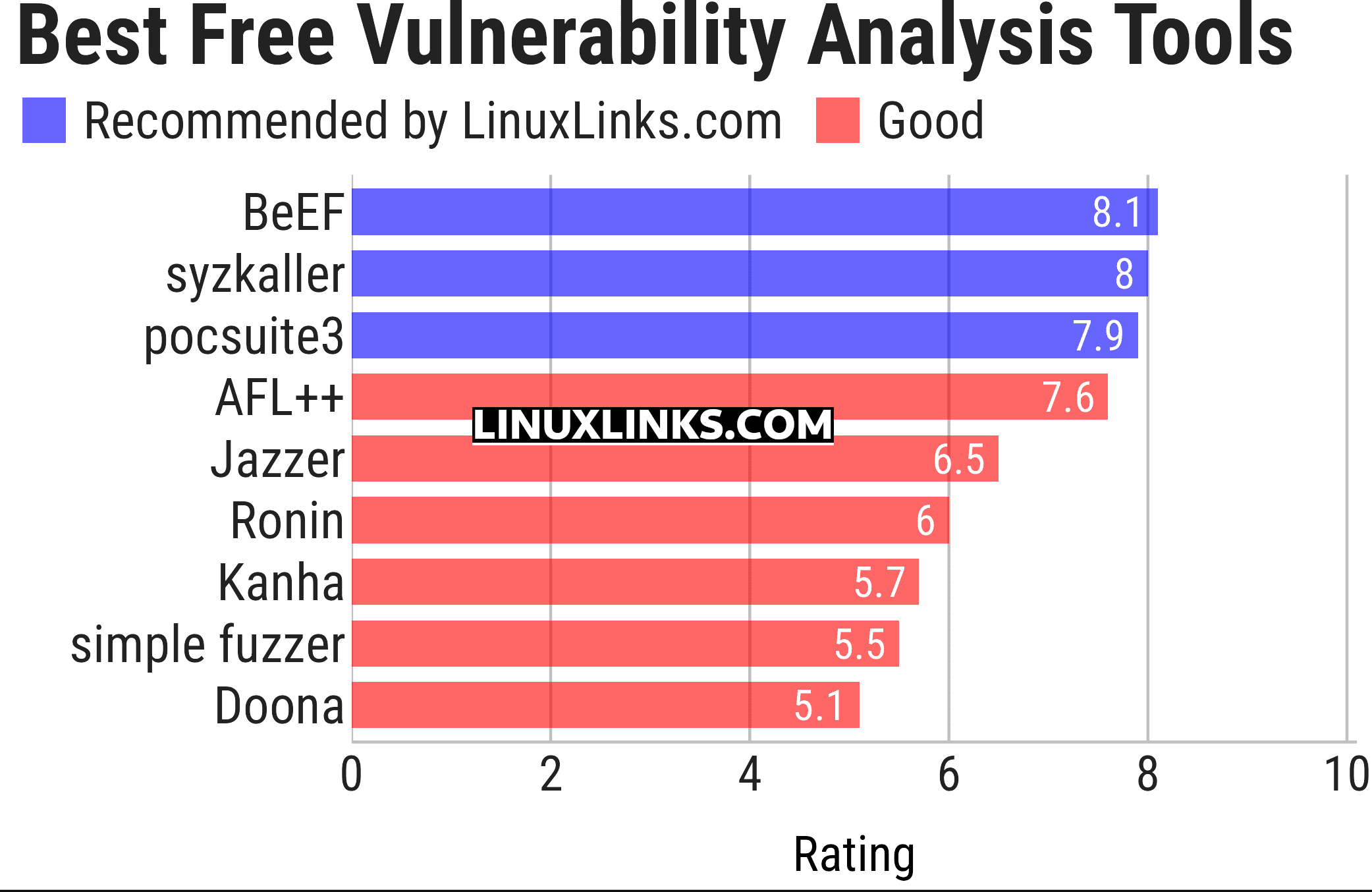
Let’s explore the 9 tools. For each application we have compiled its own portal page, a full description with an in-depth analysis of its features, together with links to relevant resources.
| Vulnerability Analysis Tools | |
|---|---|
| BeEF | The Browser Exploitation Framework |
| syzkaller | Unsupervised, coverage-guided kernel fuzzer |
| pocsuite3 | Remote vulnerability testing framework |
| AFL++ | Security-oriented fuzzer |
| Jazzer | Coverage-guided, in-process fuzzer for the Java Virtual Machine |
| Ronin | Ruby toolkit for security research and development |
| Kanha | Web-app pentesting suite |
| simple fuzzer | A fuzzer with two network modes of operation |
| Doona | Fork of the Bruteforce Exploit Detector Tool |
This article has been updated to reflect the changes outlined in our recent announcement.
 Explore our carefully curated directory of recommended free and open source software, covering every major software category. Explore our carefully curated directory of recommended free and open source software, covering every major software category.The directory forms part of our extensive collection of articles for Linux enthusiasts. It includes hundreds of detailed reviews, together with free and open source alternatives to proprietary software from companies such as Google, Microsoft, Apple, Adobe, IBM, Cisco, Oracle, and Autodesk. LinuxLinks also covers interesting projects worth exploring, Linux-compatible hardware, free programming books and tutorials, and much more. Know a useful free and open source Linux application that we haven’t covered? Tell us about it using our submission form. |
Please read our Comment Policy before commenting.