

Roundup is a simple-to-use and install issue-tracking system with command-line, web and e-mail interfaces. It is based on the design from Ka-Ping Yee in the Software Carpentry “Track” design competition.
Roundup manages a number of issues (with flexible properties such as “description”, “priority”, and so on) and provides the ability to: (a) submit new issues, (b) find and edit existing issues, and (c) discuss issues with other participants.
The system will facilitate communication among the participants by managing discussions and notifying interested parties when issues are edited. One of the major design goals for Roundup that it be simple to get going. Roundup is therefore usable “out of the box” with any python 2.7 or 3.4+ installation. It doesn’t even need to be “installed” to be operational, though an install script is provided.
It comes with issue tracker templates (a classic bug/feature tracker and a minimal skeleton) and database back-ends including sqlite, mysql and postgresql.
Key Features
- Simple to use:
- accessible through the web (html, REST or XMLRPC), email, command-line or Python programs
- may be used to track bugs, features, user feedback, sales opportunities, milestones, …
- automatically keeps a full history of changes to issues with configurable verbosity and easy and access to information about who created or last modified any item in the database
- issues have their own mini mailing list (nosy list) users may sign themselves up, there may be automatic signup for incoming email and users may handle their own password reset requests
- Highly configurable:
- Web interface HTML is fully editable.
- Database schema is also fully editable (only the “user” class is required) with a full set of data types (including dates and many-to-many relations) across all storages available.
- Authorization is fine grained and can be based on the properties of a user and resource (ABAC, PBAC (Attribute or Policy/Purpose Based Access Control)).
- Customised automatic auditors and reactors may be written that perform actions before and after changes are made to entries in the database, or may veto the creation or modification of items in the database.
- Samples are provided for all manner of configuration changes and customisations.
- Fast, scalable:
- With the sqlite, mysql and postgresql backends, roundup is also fast and scalable, easily handling thousands of issues and users with decent response times
- Database indexes are automatically added for those backends that support them (sqlite, mysql and postgresql)
- Indexed text searching giving fast responses to searches across all messages and indexed string properties
- Support for the Xapian, Whoosh. sqlite or postgres full-text indexing engines for large trackers
- Web interface:
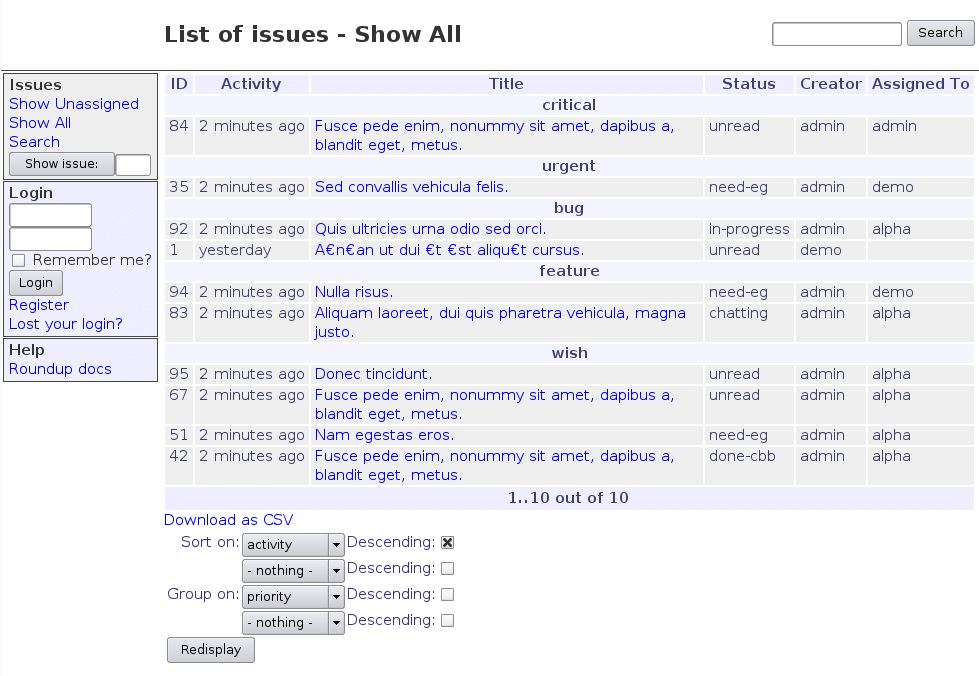
- Fully editable interfaces for listing and display of items.
- Extendable to include wizards, parent/meta bug displays, …
- Differentiates between anonymous, known and admin users.
- Set up to require login, and may also only allow admin users to register new users.
- Authentication of user registration and user-driven password resetting using email and one time keys.
- Run using WSGI or through CGI as a normal cgi script, as a stand-alone web server, under mod_wsgi (mod_python is deprecated) or through Zope.
- Searching may be performed using many constraints, including a full-text search of messages attached to issues.
- File attachments (added through the web or email) are served up with the correct content-type and filename.
- Email change messages appear to be sent by the person who made the change, but responses will go back through the nosy list by default.
- Flexible access control built around Permissions and Roles with assigned Permissions.
- Generates valid HTML4 or XHTML.
- Detects concurrent user changes.
- Saving and editing of user-defined queries which may optionally be shared with other users.
- E-mail interface:
- Set up using sendmail-like delivery alias, POP polling or mailbox polling.
- Auto-register users who send in mail and aren’t known to roundup.
- Nosy list configuration controls how people are added and when messages are sent to the list.
- Auto-filing of “unformatted” messages into a particular class.
- e-mail attachments are handled sanely, being attached to the issue they’re intended for, and forwarded on to the nosy list.
- Sane handling of content-type and content-encoding of messages (text/plain preferred in all situations).
- Email packages that display threading will show issue messages correctly threaded.
- Send messages from multiple addresses and be associated with the same roundup username.
- Built-in security features like TLS and APOP.
- Command-line:
- Interactively manage roundup databases.
- Scriptable with standard shell scripting.
- API available for other Python-based software.
- Variety of sample shell scripts are provided (weekly reports, issue generation, …).
- xmlrpc interface:
- Simple remote tracker interface with basic HTTP authentication available at the /xmlrpc endpoint.
- Provides same access to tracker as roundup-admin, but based on XMLRPC calls
- RESTful interface
- Accessible using basic HTTP authentication at /rest starting point.
- Extend with new endpoints.
- Authentication using JSON Web Tokens (JWT).
- CORS support for use by third party web pages.
Website: www.roundup-tracker.org
Support: Documentation
Developer: Richard Jones
License: A number of open source licenses
Roundup is written in Python. Learn Python with our recommended free books and free tutorials.
Related Software
| Customer Service Trouble Ticketing Software | |
|---|---|
| Zammad | Web based helpdesk/customer support system with bags of features |
| Request Tracker | Mature enterprise-grade issue tracking system |
| osTicket | Widely-used lightweight support ticket system |
| Roundup | Simple to use and install issue tracking system |
| Libredesk | Self-hosted omnichannel customer support desk |
| FreeScout | Self-hosted help desk and shared mailbox application |
| Frappe Helpdesk | Customer service and ticket management application |
| Znuny | Fork of OTRS |
| OpenSupports | Simple ticketing system |
Read our verdict in the software roundup.
| Issue Tracking Systems | |
|---|---|
| OpenProject | Collaborative project management with planning and tracking |
| Zammad | Web based open source helpdesk/customer support system |
| Plane | Modern project management for issues, cycles, and roadmaps |
| Request Tracker | Mature enterprise-grade issue tracking system |
| MantisBT | Issue tracker implemented in PHP and using MySQL as a database |
| osTicket | Customer support ticket system |
| Fossil | Distributed version control system, bug tracking system and wiki server |
| Bugzilla | Bug Tracking System available through a web interface |
| Roundup | Simple-to-use and install issue-tracking system |
| Trac | Issue tracker implemented in PHP and using MySQL as a database |
| Redmine | Flexible project management web application |
| Flyspray | Simple, web-based bug tracking system written in PHP |
| Znuny | Fork of OTRS |
| Eventum | User friendly and flexible issue tracking system |
| FlowInquiry | Manage tickets, workflows and SLA tracking |
| Pachno | Friendly issue tracking |
| OpenSupports | Simple ticketing system |
| Phorge | Ccmmunity-maintained fork of Phabricator |
| Qisutu | Straightforward ticket management for teams and support workflows |
Read our verdict in the software roundup.
 Explore our comprehensive directory of recommended free and open source software. Our carefully curated collection spans every major software category. Explore our comprehensive directory of recommended free and open source software. Our carefully curated collection spans every major software category.This directory is part of our ongoing series of informative articles for Linux enthusiasts. It features hundreds of detailed reviews, along with open source alternatives to proprietary solutions from major corporations such as Google, Microsoft, Apple, Adobe, IBM, Cisco, Oracle, and Autodesk. You’ll also find interesting projects to try, hardware coverage, free programming books and tutorials, and much more. Discovered a useful open source Linux program that we haven’t covered yet? Let us know by completing this form. |
Please read our Comment Policy before commenting.
Please update this entry.
It runs on python 3.6+ or python 2.7+. It has 5 templates including some designed for software bug tracking.
In addition to web browser access, it also has a REST interface for access from a single page app (SPA), javascript, or for communicating with other software