

Data compression is the process of storing data in a format that uses less space than the original representation would use. Compressing data can be very useful particularly in the field of communications as it enables devices to transmit or store data in fewer bits. Besides reducing transmission bandwidth, compression increases the amount of information that can be stored on a hard disk drive or other storage device.
There are two main types of compression. Lossy compression is a data encoding method which reduces a file by discarding certain information. When the file is uncompressed, not all of the original information will be recovered. Lossy compression is typically used to compress video, audio and images, as well as internet telephony. The fact that information is lost during compression will often be unnoticeable to most users. Lossy compression techniques are used in all DVDs, Blu-ray discs, and most multimedia available on the internet.
However, lossy compression is unsuitable where the original and the decompression data must be identical. In this situation, users need to use lossless compression. This type of compression is employed in compressing software applications, files, and text articles. Loseless compression is also popular in archiving music.
This roundup focuses on parallel lossless compression tools only.
Some traditional lossless compression tools include gzip, and bzip2. When compressing and decompressing files these tools use a single core. But these days, modern processors have multiple cores. You won’t see the speed advantage modern processors offer with the traditional tools. Step forward modern compression tools that use all the cores present on your system when compressing files, offering massive speed advantages.
Here’s our verdict captured in a legendary LinuxLinks-style ratings chart. Only free and open source software is eligible for inclusion.
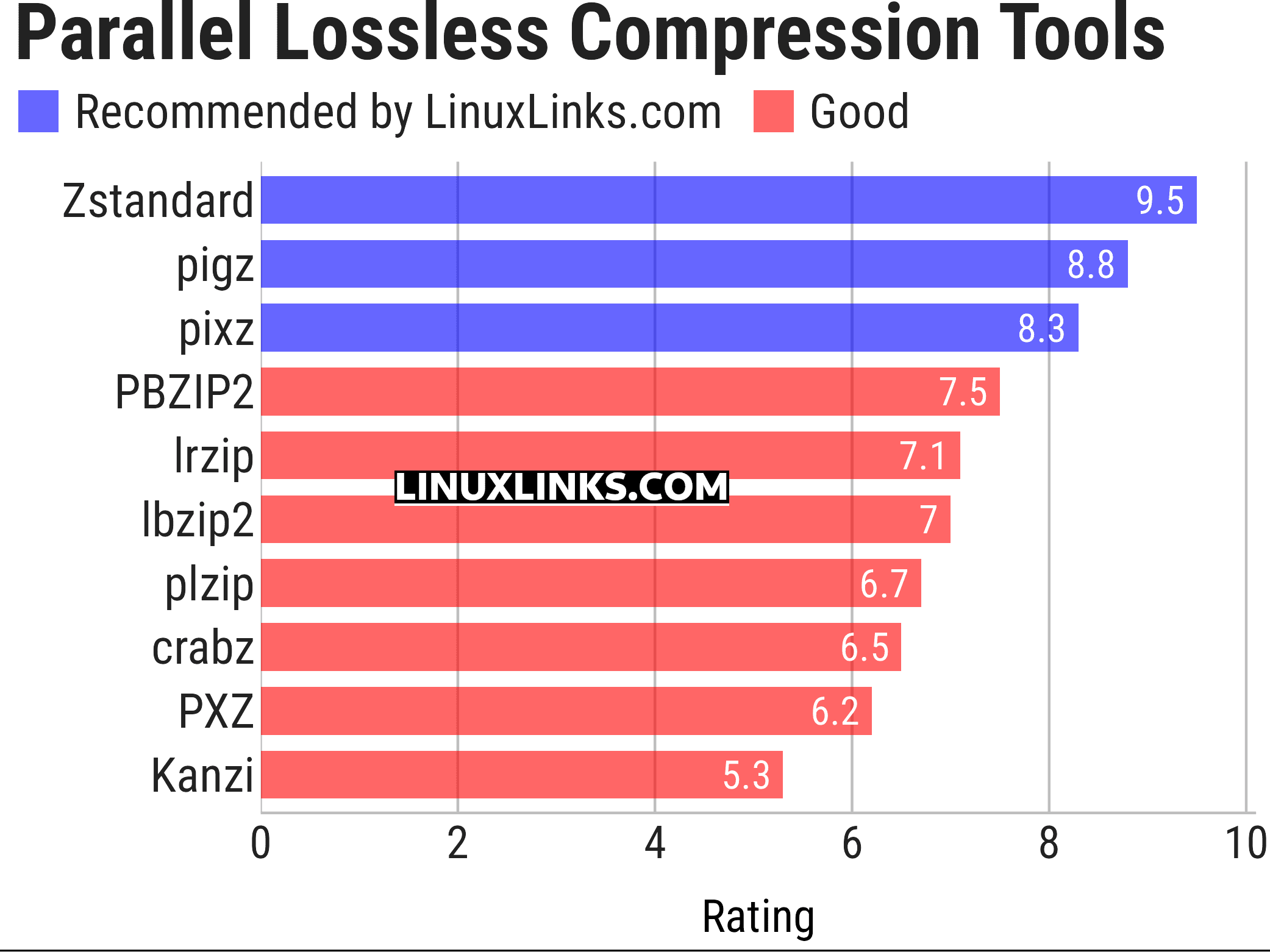
Click the links in the table below to learn more about each tool.
| Multi-Core Compression Tools | |
|---|---|
| Zstandard | Fast compression algorithm, providing high compression ratios |
| pigz | Parallel implementation of gzip. It's a fully functional replacement for gzip |
| pixz | Parallel indexing XZ compression, fully compatible with XZ. LZMA and LZMA2 |
| PBZIP2 | Parallel implementation of the bzip2 block-sorting file compressor |
| lrzip | Compression utility that excels at compressing large files |
| lbzip2 | Parallel bzip2 compression utility, suited for serial and parallel processing |
| plzip | Massively parallel (multi-threaded) lossless data compressor based on lzlib |
| crabz | Like pigz but written in Rust |
| PXZ | Runs LZMA compression on multiple cores and processors |
| Kanzi | Modern lossless data compressor |
This article has been updated to reflect the changes outlined in our recent announcement.
 LinuxLinks helps you discover the best free and open source software for Linux. Explore our extensive collection of recommended applications, including alternatives to popular proprietary software. We also publish software reviews, Linux tutorials, hardware reviews, free programming books and articles covering the wider open source community. Browse our Linux resources to discover more. Know a useful free and open source Linux application we haven't covered? Suggest a program for inclusion. Has your software been featured on LinuxLinks? Display one of our Featured on LinuxLinks badges on your website or GitHub README. |
Please read our Comment Policy before commenting.