

Tunneling is a way to cross terrain or boundaries that cannot normally be crossed.
Similarly, in networking, tunnels are a method for discretely transmitting data across a network using protocols that are not supported by that network. Tunneling works by encapsulating packets: wrapping packets inside of other packets. Tunneling involves six key processes: encryption, encapsulation, header addition, transmission, decapsulation, and decryption.
Network tunnels provide a direct connection between a remote server and the local network, and the transmission of data is undetectable by the public network.
One big advantage of tunneling is that it allows remote workers and field teams to safely work offsite without compromising personal or organizational security. Other practical use cases include remote support, disaster recovery, safe supply chain management, network monitoring, and more.
Here’s our verdict captured in a legendary LinuxLinks-style ratings chart. All of the programs in this roundup are free and open source software.
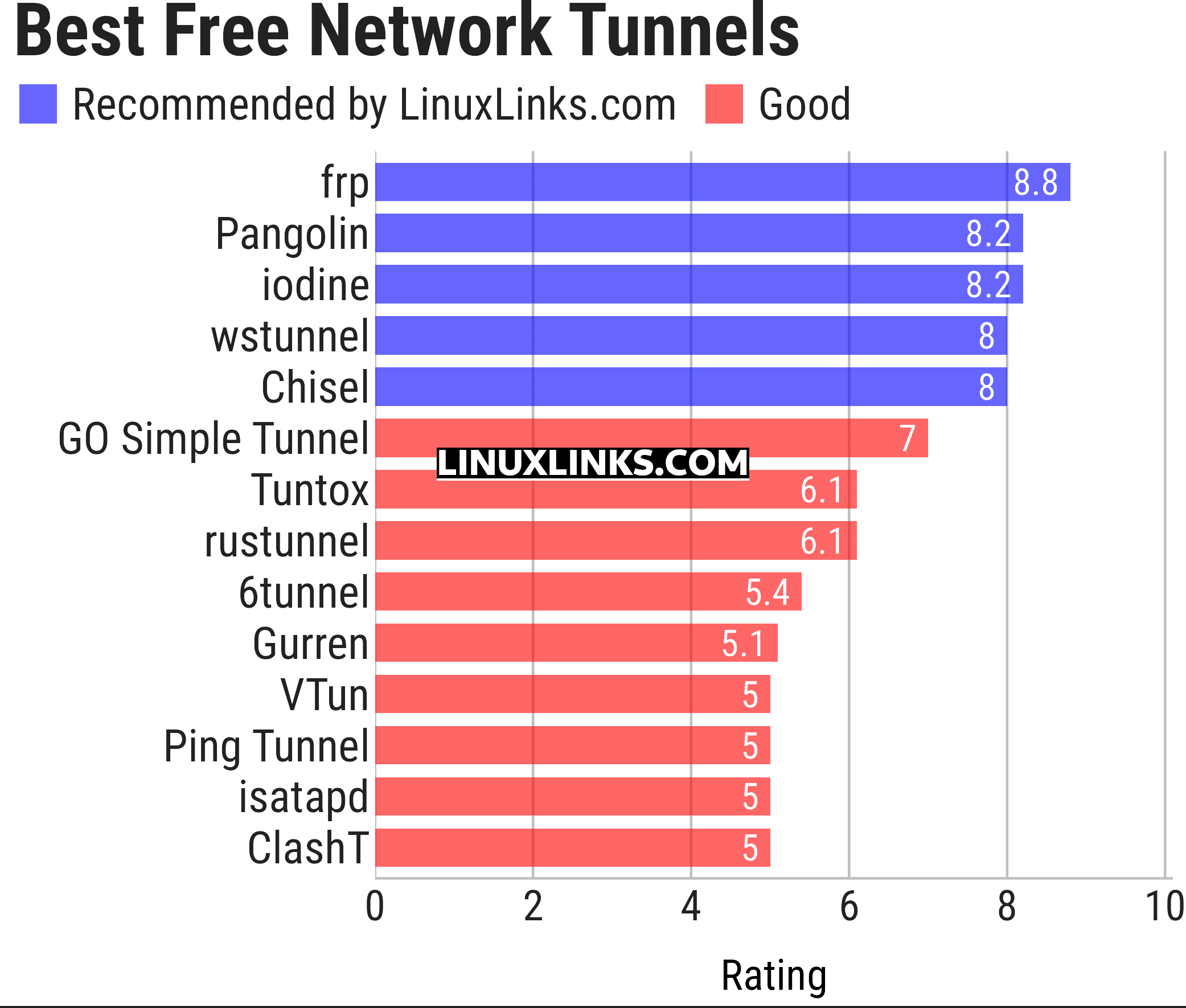
Click the links in the table below to learn more about each tool. The software is listed in alphabetical order.
| Network Tunnels | |
|---|---|
| frp | Fast reverse proxy |
| Pangolin | Tunneled mesh reverse proxy server with access control |
| iodine | Tunnel IPv4 data through a DNS server |
| wstunnel | Tunnel traffic over Websocket or HTTP2 |
| Chisel | Fast TCP/UDP tunnel |
| GO Simple Tunnel | Provides proxying, port forwarding, and reverse proxy capabilities |
| Tuntox | Forwards TCP connections over the Tox protocol |
| rustunnel | Secure tunnelling platform |
| 6tunnel | Tunnelling for applications that don't speak IPv6 |
| Gurren | SSH tunnel manager |
| VTun | Create virtual tunnels over TCP/IP networks |
| Ping Tunnel | Tunnel TCP connections to a remote host using ICMP echo request |
| isatapd | Creates and maintains an ISATAP tunnel |
| ClashT | Rule-based tunnel in Go |
This article has been updated to reflect the changes outlined in our recent announcement.
 Explore our comprehensive directory of recommended free and open source software. Our carefully curated collection spans every major software category. Explore our comprehensive directory of recommended free and open source software. Our carefully curated collection spans every major software category.This directory is part of our ongoing series of informative articles for Linux enthusiasts. It features hundreds of detailed reviews, along with open source alternatives to proprietary solutions from major corporations such as Google, Microsoft, Apple, Adobe, IBM, Cisco, Oracle, and Autodesk. You’ll also find interesting projects to try, hardware coverage, free programming books and tutorials, and much more. Know a useful open source Linux program that we haven’t covered yet? Let us know by completing this form. |
Please read our Comment Policy before commenting.